
Ghost of Tsushima: How a PS4 Swan Song Became a 2026 Samurai Saga
Ghost of Tsushima and its PS4 reveal shaped a landmark samurai epic, tracing Jin Sakai’s transformation into the Ghost and PlayStation fame.
In 2026, Ghost of Tsushima no longer needs an introduction. Sucker Punch Productions' open-world samurai epic, once positioned as one of the final major exclusives for the PlayStation 4, has grown into a defining title for its generation and a lasting franchise. But the game's first major wave of anticipation crested in late 2019, when Sony and Sucker Punch used The Game Awards to release a new trailer and a collection of screenshots captured on PS4 Pro in 4K. Those images, filled with wind-swept fields, moonlit duels, and a lone warrior on horseback, offered the clearest look yet at what the studio was building.
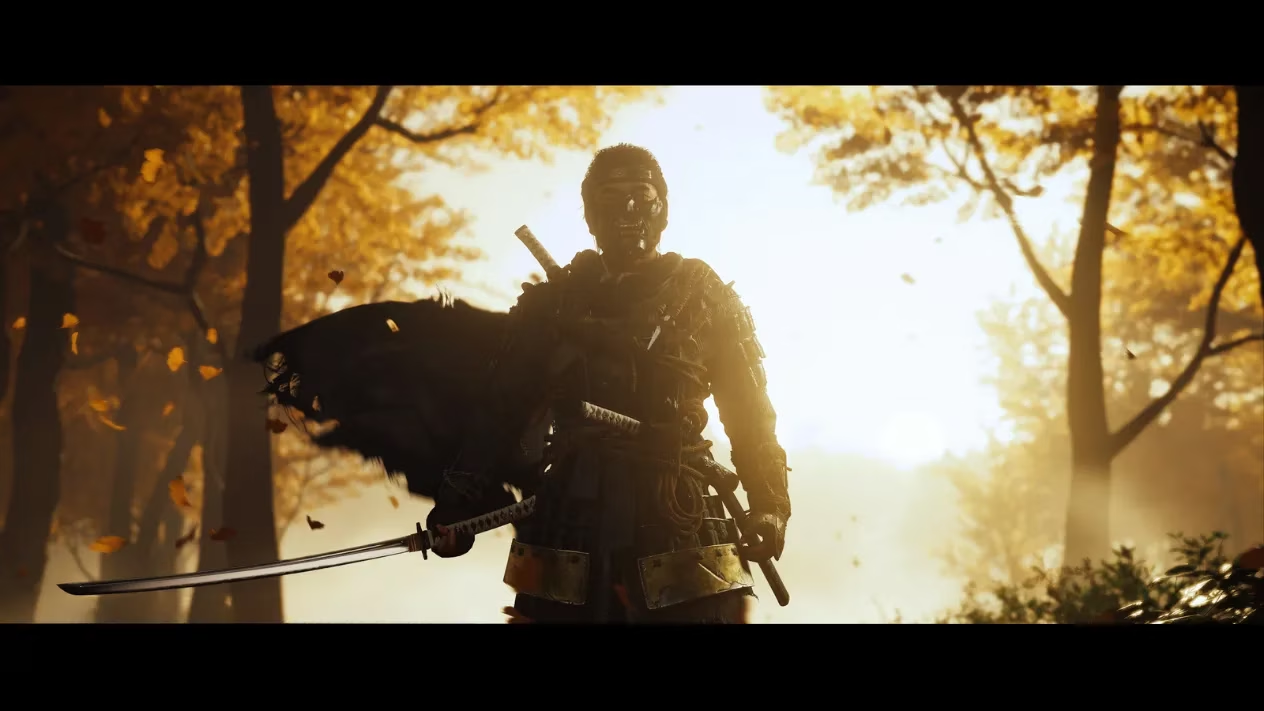
At the time, Ghost of Tsushima was still months away from its summer 2020 launch. The trailer and screenshots did more than show off scenery; they introduced the game's central promise: a story about identity, survival, and the cost of abandoning tradition. According to Sucker Punch, players would step into the role of Jin, a noble samurai who adopts a series of different identities to save his homeland. 'The Ghost' was one of them, a figure born from necessity rather than honor. Jin begins as a samurai, but he learns skills and adopts tactics that are decidedly not samurai-like. That tension between discipline and deception became the narrative and mechanical spine of the finished game.
A Warrior With Many Faces
The studio's PlayStation Blog post at the time emphasized that Jin's transformation would not be a simple power fantasy. He would have to sacrifice parts of his old self. The game's marketing leaned into that duality: the upright samurai who follows a code, and the shadowy Ghost who strikes from the grass, uses smoke bombs, and terrifies enemies. In 2026, that duality remains one of the most discussed aspects of the game. It gave players a clear role-playing hook and helped distinguish Ghost of Tsushima from other open-world action titles.
Sucker Punch also revealed that Ghost of Tsushima was 'the biggest game Sucker Punch has ever made by a wide margin.' The studio promised more information in the coming months, including details about Jin himself, the threats he would face, the allies who would help him, and what he would have to give up to become this new kind of warrior. That promise was fulfilled through a steady drumbeat of trailers, gameplay demonstrations, and interviews leading up to release.
From Summer 2020 to a Franchise
Ghost of Tsushima launched exclusively for PS4 in summer 2020, arriving as one of the platform's final major first-party showcases. It was later enhanced for PS5, received a Director's Cut with the Iki Island expansion, and eventually came to PC. The game's critical and commercial success turned a risky new IP into a cornerstone series for PlayStation. In 2025, Sucker Punch followed it with Ghost of Yotei, a new chapter set centuries later and featuring a new protagonist, Atsu. By 2026, the franchise spans multiple generations of hardware and a growing audience.
| Key Detail | Information |
|---|---|
| Developer | Sucker Punch Productions |
| Initial reveal | The Game Awards 2019 |
| Original release | Summer 2020, PS4 |
| Later versions | Director's Cut, PS5, PC |
| Sequel | Ghost of Yotei (2025) |
The 2019 screenshots remain a useful time capsule. They show a game that was already confident in its art direction: pampas grass bending in the wind, torii gates standing in silence, and Jin's silhouette against a burning sky. Those visual choices became signatures of the final product. The game's use of wind as a navigation tool, its minimalist HUD, and its focus on cinematic duels all grew from the same design philosophy visible in those early images.
Why It Still Matters in 2026
In 2026, the conversation around Ghost of Tsushima has shifted from anticipation to legacy. The game helped popularize a new wave of samurai-themed media, and its success proved that a new IP from Sucker Punch could stand alongside established PlayStation franchises. The original pitch—Jin as a samurai who becomes something else—still resonates because it treats transformation as a loss, not just an upgrade. Players remember the story not only for its swordplay but for the moments when Jin chooses the Ghost over the samurai code.
The reference material from 2019 captured a studio on the verge of a major release, promising more details about Jin, his enemies, his allies, and his sacrifices. In 2026, those details are history. Ghost of Tsushima has become a benchmark for open-world design, a showcase for PlayStation's visual ambitions, and the foundation of a franchise that continues with Ghost of Yotei. What was once described as the PS4's swan song is now a lasting samurai saga. 🏯⚔️
This discussion is informed by CNET - Gaming, whose reporting on how hardware shifts and display tech shape player expectations helps contextualize why Ghost of Tsushima's 2019 PS4 Pro 4K screenshots landed so powerfully—signaling a late-generation showcase where cinematic composition, minimalist UI choices, and performance-aware visual design could elevate an open-world title into a cross-generational franchise touchstone by 2026.