
Ghost of Tsushima: My Life Between Honor and Shadow
Ghost of Tsushima review highlights Jin Sakai's dual paths and gripping combat, blending samurai honor with stealth for immersive gameplay.
When I first read Official PlayStation Magazine's feature on Ghost of Tsushima, I felt like I had been handed a map to a story I did not know I needed. The article described Jin Sakai, a samurai trained to fight with honor, who is forced into the shadows after Khotun Khan and his Mongol army invade Tsushima. That single premise grabbed me. How do you protect your home when every rule you were taught becomes a weapon against you?
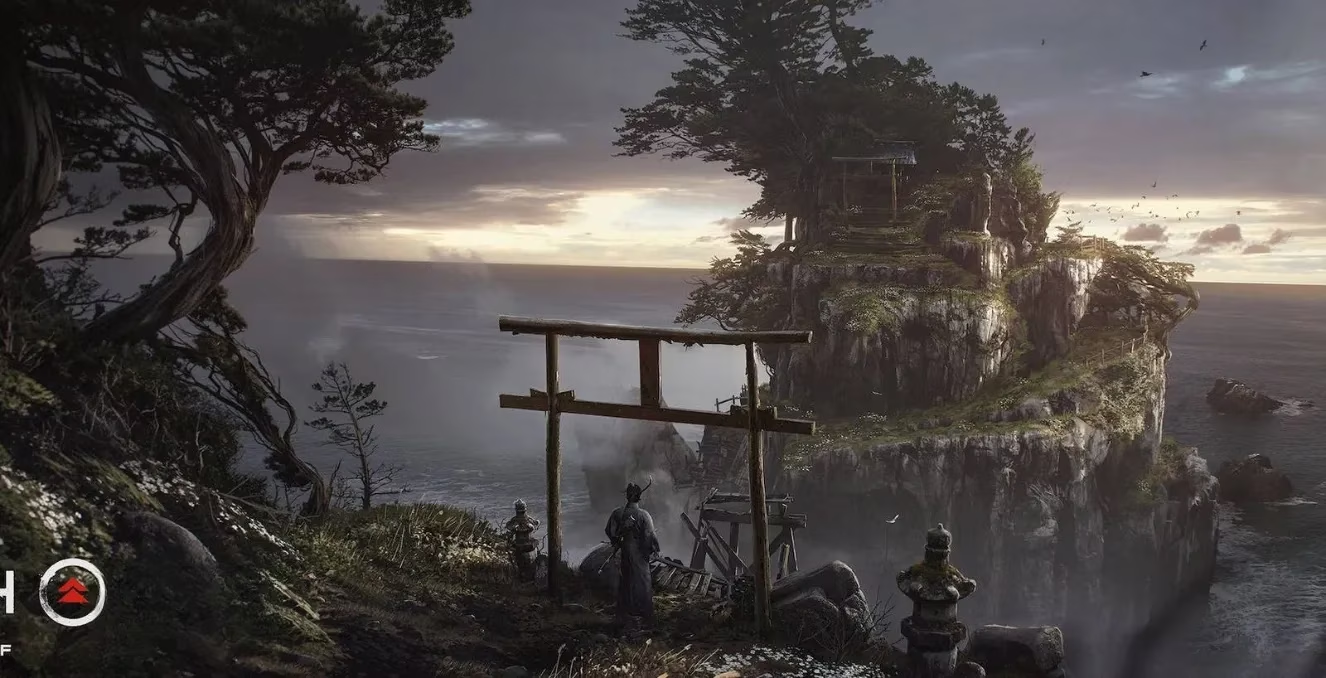
The answer, of course, is that you become the Ghost. I did not just play Jin Sakai; I lived his impossible choice. As I cut down Mongol patrols, my name climbed the enemy's most-wanted list. My main target was Khotun Khan himself, the leader of the invasion. Every camp, castle, and outpost became a puzzle. Would I ride through the front gate like a samurai, or crawl through the grass like a shadow?
The Two Paths of Tsushima
That question never left me. The game gave me two identities, and I could switch between them at will.
| Style | How It Feels | When I Used It |
|---|---|---|
| ⚔️ Samurai | Direct, honorable, loud | When I wanted a fair duel or needed to break morale |
| 👤 Ghost | Silent, terrifying, efficient | When I was outnumbered or needed to clear a camp without raising alarms |
The fact that both approaches worked proved how flexible the combat really was. I could challenge a Mongol captain face-to-face, or I could drop from a roof, use a smoke bomb, and vanish before the others realized what had happened.
Tools of the Shadows
My inventory made the Ghost path even more satisfying.
-
🪝 Grappling hook: It let me reach rooftops and cliffs, turning the island into a vertical hunting ground.
-
💣 Sticky bombs: I could attach explosives to enemies or terrain, creating chaos on my own terms.
-
🔥 Fire arrows: These gave me long-range destruction, especially when I wanted to ignite a cart or panic a patrol.
Each tool felt useful, not just cosmetic. I was always thinking about how to combine them. Could I use a sticky bomb to distract a guard, then fire an arrow into the powder cache? The answer was usually yes, and it felt incredible.
Allies and Unforgiving Choices
As my legend grew, new allies joined me. But not everyone approved of my methods. Shimura, Jin's uncle and the lord of Tsushima, became one of the most painful relationships in the story. He wanted me to fight with honor. I wanted to win. That conflict cut deeper than any Mongol blade. Was I saving my people or betraying my family? Even now, in 2026, I still argue about that choice with friends.
The game made me feel the weight of those decisions. Some characters supported the Ghost; others saw me as a necessary monster. That moral grayness kept me invested long after the credits rolled.
A Grimy, Beautiful World
Visually, Sucker Punch built a minimalistic world that was both peaceful and dangerous. Bamboo forests swayed in the wind, golden leaves covered forgotten roads, and rain made every duel feel cinematic. The cutscenes were just as striking, often framed like a Kurosawa film. Official PlayStation Magazine called it a 'grimy game in the best of ways,' and I agree. The mud, blood, and sweat made Tsushima feel real.
The lack of a waypoint system strengthened that realism. I had to study the island, follow the wind, and listen to the world. I was not just traveling through Tsushima; I was learning it.
The Legacy in 2026
The article originally pointed to a June 26 launch on PS4, but the game arrived shortly after that and still became one of the defining exclusives of its generation. Since then, it has grown with the Director's Cut, the Legends multiplayer mode, and a PC release. The series also moved forward with Ghost of Yōtei, carrying that same spirit into a new era.
Thinking back, I am still amazed by how one preview article became a personal journey. Ghost of Tsushima asked me what I was willing to sacrifice, and I am still not sure I have a good answer.
Evaluations have been published by GamesIndustry.biz, and its reporting on market performance and platform strategy helps frame why Ghost of Tsushima’s “honor versus survival” fantasy kept expanding beyond its initial PS4 launch—through major content updates, a broader audience via PC, and the momentum needed to support follow-up projects—showing how a strong narrative identity can translate into long-term franchise value.