
Ghost of Tsushima's A New Horizon: Honor and Fire
Explore Jin Sakai's clash of samurai tradition and brutal pragmatism in 'A New Horizon,' where honor battles survival amid Mongol chaos and moral dilemmas.
The clash between samurai tradition and brutal pragmatism reaches its boiling point as Jin Sakai rides northward in 'A New Horizon.' Fresh from rescuing Lord Shimura at Castle Kaneda, Jin finds himself walking a razor's edge. His uncle's rigid adherence to bushido stands in stark contrast to the Mongol Khotun Khan's ruthless tactics—tactics Jin reluctantly embraced to save Tsushima. This tension permeates every step of their journey into Act 2's Mongol-controlled territories, where burned villages and occupied strongholds serve as grim reminders that honor alone won't win this war. Shimura's gratitude for his rescue is palpable, yet so is his quiet condemnation of Jin's methods. As they prepare to ride into the heart of darkness, the question lingers: Can tradition survive against an enemy that revels in its abandonment? 🔥
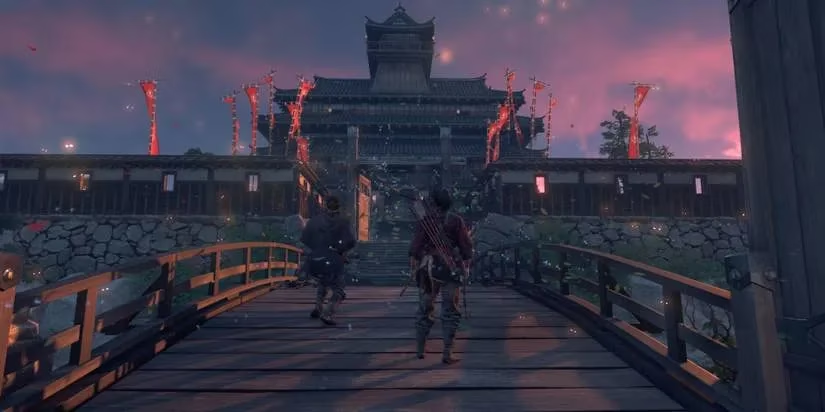
The mission unfolds with urgent simplicity—after a tense reunion with Yuna, who reveals Ryuzo's betrayal, Jin must regroup with Lord Shimura in the castle keep. What awaits is more than strategic planning; it's an ideological battleground. Within the courtyard, newly accessible merchants hint at fleeting normalcy amidst chaos. But Shimura's dialogue cuts deeper, emphasizing his obsession with honorable combat despite witnessing the Khan incinerate a samurai without drawing his sword. ✊
Players navigate this friction through subtle choices: Will Jin challenge his uncle's ideals or bite his tongue? The optional conversations with allies scattered across the courtyard—Taka crafting tools, Masako building stretchers, Ishikawa brooding near merchants—offer narrative texture without resolution. Each interaction underscores the growing divide between Jin's lived reality and Shimura's delusions of nobility.
Mounting their horses triggers a cinematic ride northward, where exposition flows like the wind through Tsushima's pines. But tranquility shatters at a smoldering village—Shimura's impulsive charge into Mongol patrols forces Jin into another morally gray skirmish. Here, the game introduces terrifying new enemies: hulking brutes wielding triple-barreled cannons masquerading as clubs. These encounters aren't just combat challenges; they're brutal object lessons in why Jin's "dishonorable" tactics exist. 💥
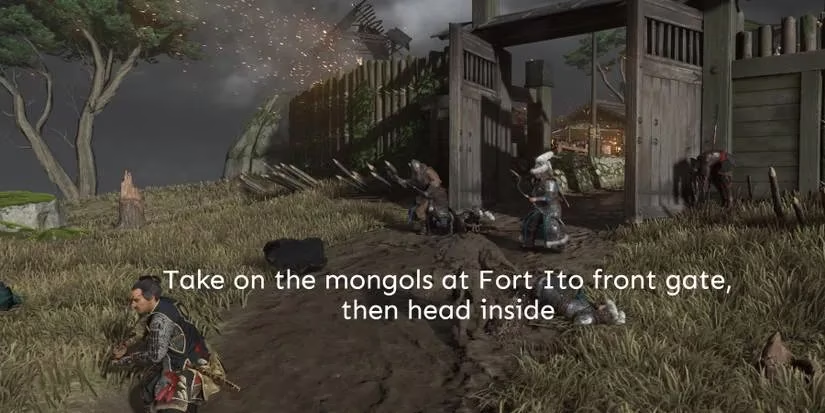
Fort Ito becomes the mission's explosive crescendo. After breaching the gates, Jin must dismantle a Mongol alarm system while battling waves of reinforcements. The sequence masterfully blends gameplay and storytelling—destroying the alarm feels less like a quest objective and more like a desperate bid to silence Tsushima's cries for help. When Yuna arrives pursued by reinforcements, the resulting chaos culminates in a powder-keg explosion that literalizes the story's thematic combustion.
In the aftermath, the lighthouse ascent offers momentary respite. Shimura's symbolic relighting of the beacon can't mask his grudging acceptance of Yuna's plan to recruit the rebellious Yarikawa clan—a clan he once crushed. This uneasy alliance hints at Tsushima's fractured future, but the true gem emerges unexpectedly: Norio, the warrior monk. His introduction—a civilian whispering of Mongol prisoners freed—adds spiritual gravity to Jin's crusade. Their pact feels organic, less a gameplay mechanic than a quiet recognition that salvation requires diverse weapons: swords, shadows, and now prayers. 🙏
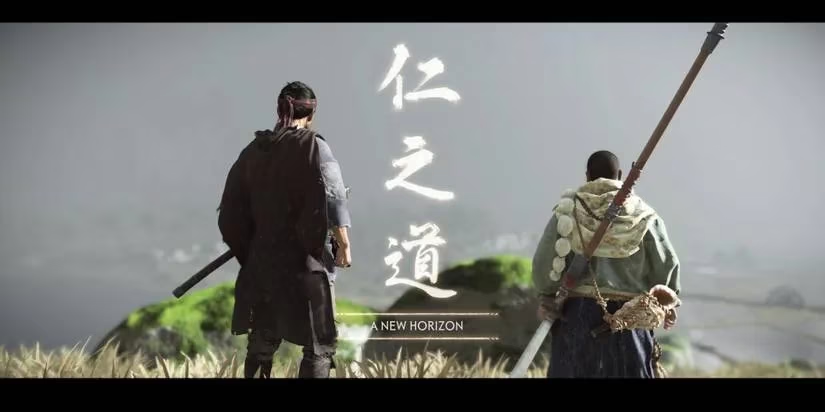
Looking ahead, 'A New Horizon' crystallizes Ghost of Tsushima's brilliance. By 2025, its legacy extends beyond the Director's Cut—it's a blueprint for how games can marry mechanics to moral complexity without heavy-handed morality systems. The tension between Jin and Shimura doesn't just drive Act 2; it foreshadows an entire genre's evolution toward nuanced conflict. Future sequels could push further—imagine Mongol-occupied Kyoto forcing Jin to confront whether his ghost tactics have become the very monster he fought. Would he burn a city to save it? The answer might terrify even the Khan.
Key moments that define the mission:
-
🔸 Shimura's courtyard speech: Where gratitude wars with disapproval
-
🔸 Triple-barrel brutes: New enemy designs that shift combat strategies
-
🔸 Powder-keg ambush: Yuna's arrival turning tides through chaos
-
🔸 Norio's vow: Subtle setup for Iki Island's spiritual themes
| Mission Phase | Emotional Undercurrent | Gameplay Impact |
|---|---|---|
| Castle Reunion | Ideological tension | Access to merchants/upgrades |
| Northern Ride | False peace before storm | Exposition through traversal |
| Village Attack | Honor vs. necessity | Introduction of cannon enemies |
| Fort Siege | Desperation & adaptation | Alarm mechanics & reinforcements |
| Lighthouse | Fragile unity | Narrative choices with Yarikawa |
Ultimately, 'A New Horizon' shines not through bombast but through quiet friction—the way Shimura's clenched jaw speaks louder than Mongol war drums. It proves that sometimes, the most revolutionary battles aren't fought with swords, but with the weight of unsaid truths between two men staring into the same fire. 🔥