
LCS 2020 Format Overhaul: A Look Back From 2026
The 2020 LCS format overhaul transformed League of Legends esports with more matches, expanded playoffs, and a direct path to MSI and Worlds.
In 2020, North American League of Legends fans had gone months without official esports content after the World Championship ended in November. The new year and Season 10 brought the League of Legends Championship Series back to the air with a revised format that promised more matches, a wilder playoff race, and a clearer path to international events. Fast forward to 2026, and that season looks like a watershed moment. The LCS brand has since been folded into the League of Legends Championship of The Americas (LTA), but the 2020 overhaul remains a blueprint for how Riot Games experimented with North American competition. It was, as old-school fans might say, a whole new ballgame. 📅
The most immediate change was the broadcast schedule. The LCS expanded to three days, with Saturday and Sunday featuring four games each, while 'Monday Night League' served up two matches under the lights. For viewers, that meant more League, more often—a far cry from the sporadic tournaments that predated the franchised era. The LCS itself was born in Season 3, when competitive play outgrew one-off events. By 2018, ten franchised teams were battling through Spring and Summer splits to decide who would represent North America at the World Championship and Mid-Season Invitational.
But 2020 did not just add airtime. It rewired the postseason. The Summer split playoff field grew from six teams to eight, while Spring remained at six. Both splits introduced an expanded loser's bracket, giving teams a second life. That change was designed to prevent a strong squad from being eliminated by a single bad day—a bit of 'don't throw the baby out with the bathwater' logic. Meanwhile, the two splits were completely separated. The Spring winner advanced to the 2020 Mid-Season Invitational, and the Summer winner punched a ticket to the 2020 World Championship. Championship Points and the Regional Qualifier were gone.
That last part was seismic. Long-time viewers had grown used to teams coasting into Worlds on points accumulated across the year. Under the new system, even a Spring finalist had to grind through Summer to reach playoffs and then Worlds. There would be no more backdoor entries. Historic feats such as Cloud 9's Cinderella run in 2015—when the team stormed through the Regional Qualifier—became impossible. The trade-off was intentional: Riot wanted North America to stop relying on past glory and start proving itself in the here and now. 🏆
| Format Element | Before 2020 | From 2020 Onward |
|---|---|---|
| Broadcast days | Two days | Three days, including Monday Night League |
| Summer playoff teams | Top 6 | Top 8 |
| Loser's bracket | Limited | Expanded |
| Worlds qualification | Championship Points + Regional Qualifier | Summer playoffs winner and seeding |
| Spring winner path | Points | Mid-Season Invitational berth |
The logic behind the changes was simple, even if the execution was controversial. North American teams had historically underperformed at the World Championship. Sending teams based solely on strong, relevant Summer dominance was meant to raise the region's ceiling. The expanded loser's bracket also had a practical benefit: it kept top teams alive after an unlucky series, allowing them to fight their way back to the finals. In a best-of-five world, variance can be a real buzzkill. The new format gave contenders a safety net without handing them a free pass. 🔥
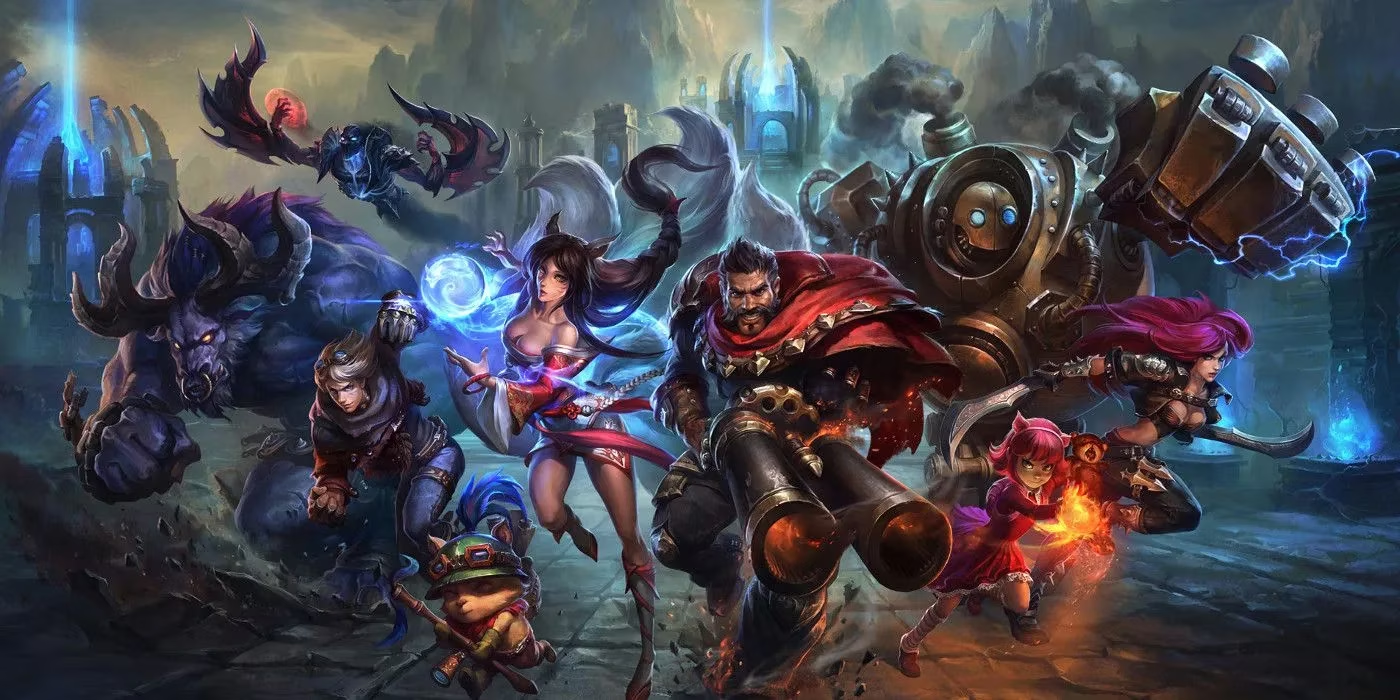
Not every fan was thrilled. Some were tired of watching the same pros run it back year after year. For them, the LCS offered five Academy matches featuring up-and-coming North American talent on Friday and scattered throughout the other days. That pipeline mattered. In 2020, it was a nod to the future; by 2026, it has become an essential part of the ecosystem, even as the LCS name has faded into the LTA era. Players could also dive into League of Legends, Teamfight Tactics, and Riot's other 2020 releases such as Legends of Runeterra while waiting for the next chapter.
The 2020 LCS season officially began on Saturday, January 25, 2020. From today's vantage point, it was both an ending and a beginning. It ended the Championship Points era and the Regional Qualifier. It began a more cutthroat, Summer-focused race that forced teams to be good when it mattered most. The LCS has since undergone even more radical changes, with the North American league now part of a broader Americas structure in 2025 and 2026. Yet the debates that surrounded the 2020 format—fairness, viewership, international competitiveness, and the balance between legacy and merit—still echo.
If anything, the 2020 overhaul was a reminder that esports leagues cannot afford to stand still. The LCS tried to shake up a region that had grown comfortable. It added Monday night lights, expanded the playoff bracket, and told teams to earn their spot the hard way. Some fans loved it, some hated it, and others simply tuned in to see if North America could finally stop being the butt of the joke at Worlds. In 2026, that question is still being asked, but the 2020 season remains a fascinating case study in how to reinvent a league—and how hard it is to change a region's reputation overnight.