
Riot Forge's First Epic: Revisiting the Ruined King Announcement That Shook Runeterra
Riot Forge's Ruined King reveal shocked fans: Airship Syndicate's turn-based RPG brought League's gritty Bilgewater lore to consoles.
Back in the golden autumn of 2020, as the League of Legends World Championship finals reached their fever pitch, Riot Games dropped a bombshell that had lore nerds, RPG lovers, and console warriors all screaming in unison. Riot Forge, the newly minted publishing label, officially pulled back the curtain on Ruined King: A League of Legends Story — and let’s just say, the hype train left the station immediately. Fast forward to 2026, and this game has already cemented its place as a cult classic, but the magic of that reveal still sends shivers down the spine. Imagine it: a single-player, turn-based RPG set in the gritty, monster-infested corners of Runeterra, coming not just to PC but to consoles for the very first time. It was a landmark moment, and the community lost its collective mind.
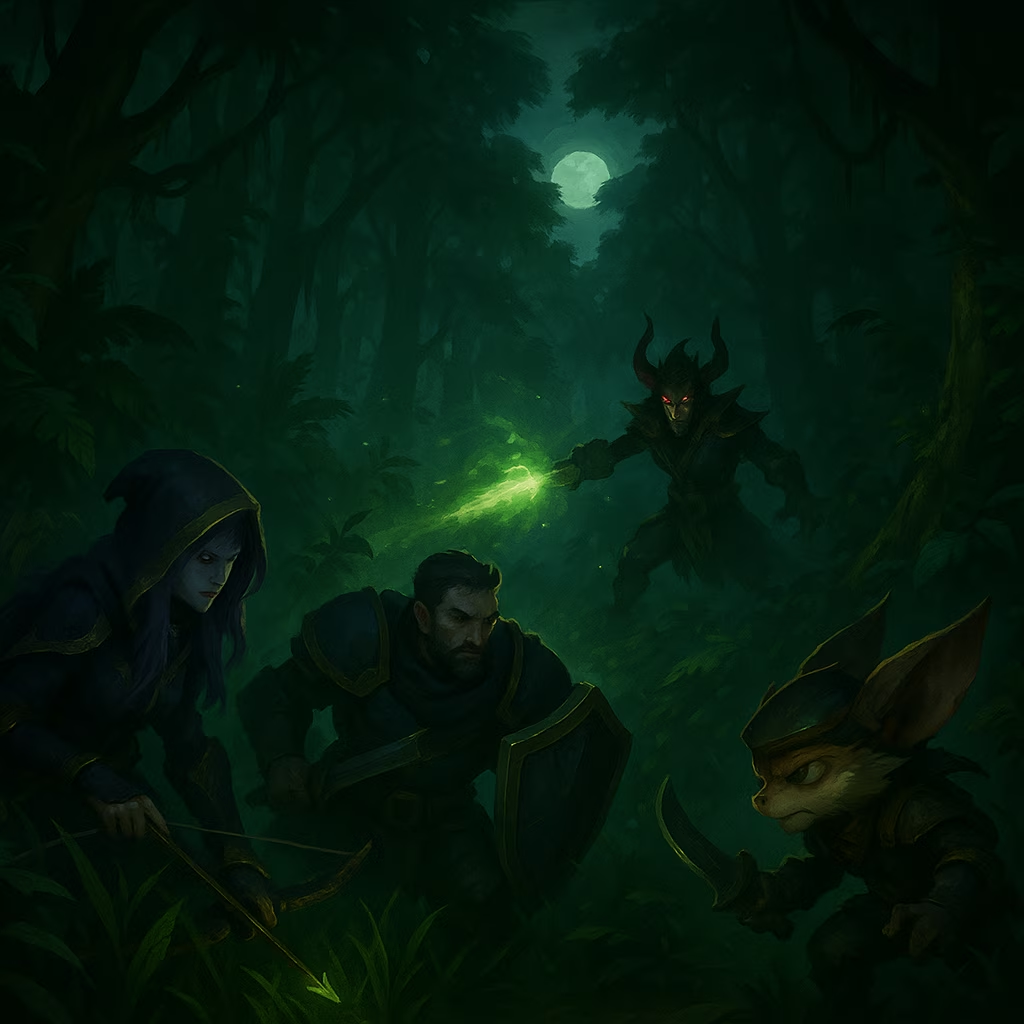
The announcement was everything we didn’t know we needed. After years of dominating the MOBA and auto-chess scenes, Riot was finally giving us a deep, narrative-driven adventure. And let’s be real — the fact that it was slated for an Early 2021 release meant the wait wasn’t excruciatingly long. From the get-go, the game was promised for PlayStation 4, Xbox One, Nintendo Switch, and PC (via Steam and the Epic Games Store). But the real cherry on top? Riot confirmed a free upgrade path to the next-gen versions for PlayStation 5 and Xbox Series X|S if you bought the current-gen edition. That kind of consumer-friendly move felt like a breath of fresh air, and honestly, it set the tone for Riot Forge’s entire publishing philosophy.
Now, let’s talk about the brains behind the brawn. The development was handed to Airship Syndicate, a studio already worshipped by fans for their work on Battle Chasers: Nightwar — a gorgeous, comic-book-inspired RPG that oozed style. And at the helm was none other than Joe Madureira, the legendary comic artist whose bold lines and larger-than-life character designs have influenced generations. When you combine Madureira’s visual storytelling with Riot’s deep champion lore, you get a match made in heaven. As Leanne Loombe, the head of Riot Forge at the time, put it so elegantly: “Ruined King is a great way to expand the world of Runeterra for brand new players as well as our dedicated League of Legends fans. Ruined King will be the first single-player game to bring the LoL universe to both consoles and PC.” That mission statement alone had casual fans and hardcore lore masters alike strapping in for an unforgettable ride.
The story premise felt like a fanfic dream come true. Set in two of Runeterra’s most treacherous and atmospheric regions — Bilgewater and the Shadow Isles — the narrative threw together an unlikely band of champions. We’re talking about a roster that reads like a who’s who of edgy anti-heroes and charismatic oddballs: Miss Fortune, the crimson-haired bounty hunter bent on revenge; Illaoi, the kraken priestess whose faith literally moves mountains; Braum, the shield-wielding himbo with a heart of pure gold; Yasuo, the guilt-ridden swordsman whose windy antics need no introduction; Ahri, the nine-tailed fox mage seeking redemption; and Pyke, the drowned revenant whose kill list makes you wonder if anyone is safe. Six champions, each with their own demons, forced to cooperate against a common enemy that lurks in the cursed Black Mist. The banter potential alone could power a small city.
For those who skipped geography class in Runeterra, a quick primer: Bilgewater is a lawless port town teeming with sea monster hunters, dock gangs, smugglers, and enough grog to drown a leviathan. It’s a place where backstabbing is practically a love language. Then you’ve got the Shadow Isles, a nightmare realm corrupted by the Black Mist — a malevolent fog that twists everything it touches into undead horrors. The contrast between the two settings promised a rollercoaster of tones, from gritty pirate intrigue to full-blown gothic horror. And Airship Syndicate nailed that aesthetic right out of the gate. Their turn-based combat system, already proven in Battle Chasers, was now supercharged with lane-based mechanics, ultimate abilities, and environmental interactions that made every fight feel like a strategic puzzle.
Joe Madureira himself couldn’t hold back his excitement during the announcement: “We couldn’t resist the chance to work with Riot Forge to expand the epic world of Runeterra. These are some of our own favorite champions, and we can’t wait for players to see how we brought the characters, creatures, and environments of Runeterra to life.” And boy, did they deliver. From Illaoi’s tentacle-smashing ult to Yasuo’s sweeping steel tempest, every ability was translated with love and a comic-book flair that made screenshots look like actual panels from a graphic novel.
Reflecting on the journey in 2026, it’s wild to think how much Ruined King paved the way. It wasn’t just a game — it was a proof of concept that League’s IP could thrive beyond the Summoner’s Rift. The game’s reception back in 2021 was a mix of steam reviews singing “never thought I’d care about Pyke’s backstory, but here I am crying” and console players finally understanding why their PC friends wouldn’t shut up about Ahri. The game also introduced the “Convergence” series that eventually led to Song of Nunu and The Mageseeker, forming a beautiful tapestry of standalone stories. But it all started with a ruined king and a crew of misfits sailing into the mist.
If you haven’t yet set sail for the Shadow Isles, 2026 is still a fantastic time to jump in. The game has aged like fine Ionian wine, with performance patches smoothing out launch hiccups and the art direction remaining timeless. Plus, with all the lore expansions Riot has cooked up since, the character moments hit even harder with hindsight. So grab your cutlass, keep an eye on the Black Mist, and remember: in Bilgewater, trust is just a betrayal waiting to happen.