
Seraphine's Timeless Melody: A Starry-Eyed Odyssey
Seraphine, the Starry-Eyed Songstress, enchants Summoner’s Rift with layered support and poke, weaving empathy into every note.
It was the autumn of 2020 when her first note shimmered across the Summoner’s Rift—a prelude woven from starlight and static, a promise draped in pink. I remember standing on the bridge of Piltover, the hextech hum beneath my feet, as if the city itself had been waiting for someone to translate its chaos into a hymn. Six years have passed, yet Seraphine remains not just a champion but a living, breathing symphony. She is the echo of a soul I never knew I needed to hear, a songbird whose feathers are plucked from the chords of empathy itself.
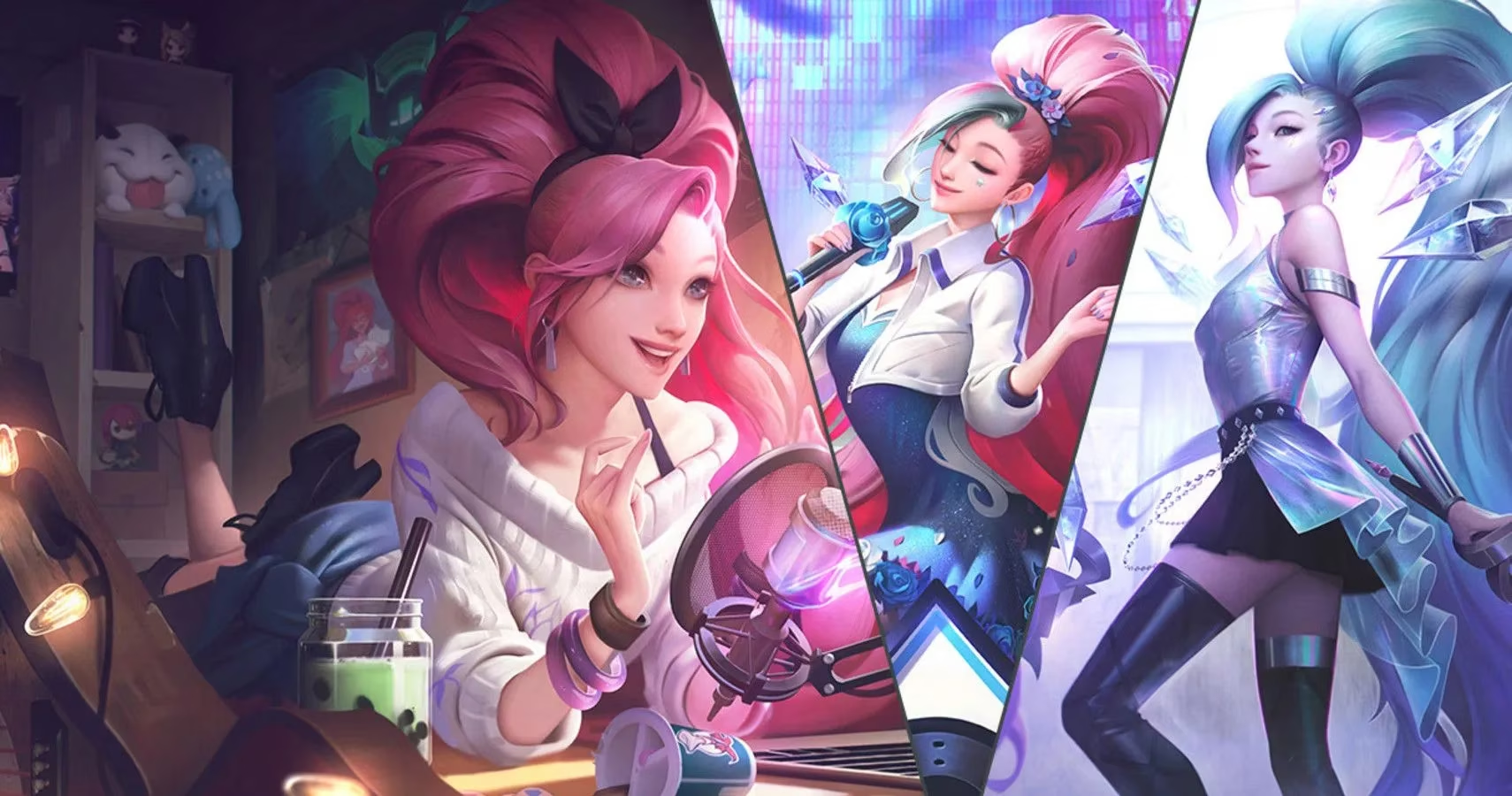
She arrived in Patch 10.22, back when the world was a different kind of loud. The developers at Riot had built her a stage long before her code went live—an official Twitter account, a questline of selfies, a crossover with K/DA. It felt like watching a star being born in real time. Yet beneath the popstar glitter lies a truth far more aching: Seraphine hears souls. Not in the metaphorical sense of a bard or a priest, but as literal melodies—a soundscape of fears, hopes, and unspoken grief that would drive anyone else to madness. She collects those fragile notes and braids them into a symphony, turning the static of suffering into something that can move a crowd to tears. In her, the cacophony of the world becomes a lullaby. I often think of that ability as a mirror that reflects not light but the inner trembling of every heart around her—a prism that fractures silence into a kaleidoscope of emotion.
Her kit, to this day, is a masterclass in layered support and poke. Stage Presence, her passive, turns every third spell into a ghostly encore—imagine a singer whose whisper suddenly becomes a choir without any visible source, a double-take of melody. Each time she casts near an ally, a luminous Note drifts into her orbit, granting her basic attacks a delicate reach and a shimmer of magic damage. Those Notes are not mere buffs; they are promises whispered into the air, like dandelion seeds carrying the weight of shared resolve. When she unleashes an empowered auto-attack, the screen briefly blooms with a cascade of tiny stars, a visual reminder that she fights by amplifying the light in others.
🟣 High Note (Q) — She sends forth a pure, crystalline tone that deals magic damage, and the lower the enemy’s health, the sharper the crescendo. I’ve seen that note slice through a wounded tank like a blade of frozen moonlight, yet when it first leaves her fingertips it is no more threatening than a sigh. It’s the perfect tool for laning: a poke that judges the soul, measuring how close an adversary is to breaking.
💠 Surround Sound (W) — A wave of warmth blankets Seraphine and her nearby allies, granting a surge of movement speed and a protective shield. In the thick of a teamfight, casting it feels like spreading a velvet cloak over your comrades, muffling the hurt for just a breath. If she already has a shield from another source, it even heals—a gentle tide that washes away the abrasion of battle.
🌊 Beat Drop (E) — A heavy soundwave ripples forward, slowing enemies it touches. What makes it poetry is its conditional might: if the target is already slowed, they are rooted in place, as if the music has convinced their own feet to betray them. If they are already rooted, they become stunned—a frozen tableau, a note held so long the world forgets to move. It’s here that Seraphine reveals her kinship to Sona, another musician whose chords can transform a fight. Yet their textures differ like velvet and silk. Sona’s crescendo is a sudden shout; Seraphine’s is a rising tide that understands the rhythm of restraint.
🎤 Encore (R) — The ultimate. She projects a captivating force that charms enemies, dealing magic damage and drawing them toward her like moths to a soft flame. Every champion touched—friend or foe—extends the wave’s reach, turning a simple beam into a sprawling, inevitable wave of beauty and betrayal. Allies struck are gifted with maximum Notes, as if she murmurs a secret that leaves them brimming with potential. There is a moment, just before the charm takes hold, when the sound barrier seems to bend, and for an instant you are all suspended in a glass cathedral of pure tone. It feels like the gentle pull of a tide that carries both friend and foe into a shared dream, where for a split second, everyone is part of the same song.
In those early days, the community buzzed with comparisons: “Sona 2.0,” they called her. I understand the reflex. Two musical supports, both women of ethereal grace, both wielding auras and debilitating harmonies. Yet Ryan “Reav3” Mireles, the lead champion producer at the time, urged us to play her first. I remember reading his Reddit reply at 3 a.m., a little defensive, a little weary, yet undeniably confident: “Many people had similar reactions to Lillia, Yone, and Samira, but once you play those champs in game they feel very unique and different.” He was right. Seraphine is not an echo of Sona; she is the resonance that comes after the note has faded. Sona conducts silence with the authority of a maestro, but Seraphine listens to what the silence hides. One is the instrument; the other is the ear.
Now, in 2026, Seraphine has grown into a fixture of the Rift. She has seen balance shifts, item reworks, and the ever-turning meta, yet her core identity remains unsullied. I’ve piloted her through seasons where enchanter supports were scorned and through metas where she was first-pick material. What never changed is the quiet intimacy of her gameplay. Laning with Seraphine is like tending a garden of sound: you poke with High Note, shield with Surround Sound, and wait for the perfect moment to root a greedy assassin with Beat Drop. And when the team gathers for a desperate siege, casting Encore becomes an act of trust—that your allies will follow the wave you’ve sent, that they will become the harmony to your melody.
I think of a particular game from last season, a nail-biting best-of-three in ranked. We were down to our inhibitor turrets, the enemy team a mass of armor and rage. The air was thick with the smell of defeat. Then, a flash of pink—Seraphine stepped forward. The enemy’s front line, overconfident, had clumped together. With a single R, I charmed three of them from max range, the wave cascading through my own team to grant them Notes. My Q echoed with Stage Presence, tearing through the carry as my E rooted the support mid-dash. It was a symphony of destruction composed in three heartbeats. In that moment, she was no longer just a champion; she was the thread that sewed scattered stars into a constellation—a galaxy born from perfect positioning.
Over the years, I have collected her skins—the ethereal K/DA ALL OUT, the graceful Graceful Phoenix, the haunting Battle Dove. Each skin doesn’t just change her outfit; it alters the timbre of her soul. On the phoenix skin, her abilities flare with rebirth fire; on Battle Dove, her notes drip with a somber gray. Yet no matter the guise, her essence remains that of a girl who once sat alone in her room, overwhelmed by the noise of the city, and taught herself to turn that noise into hope.
If you stand still in the Howling Abyss or hover over her portrait in the lobby, you might catch a faint, humming melody. It’s the sound of her constant, gentle listening. Seraphine taught me that strength doesn’t have to scream. Sometimes it’s a lullaby, a beat drop, an encore that says: you are not alone in this pandemonium. And in a game that often celebrates brutality, that is the most rebellious music of all.