
Seraphine: The Pop Star Who Shattered Runeterra's Vibe
Seraphine's lore failure shattered League of Legends immersion as Riot's pop-star marketing clashed with Piltover and Zaun's gritty world.
I still remember the autumn of 2026, when I fired up my PC to see what new madness Riot had cooked up for us. That season, every League of Legends player worth their salt was drowning in Seraphine hype. Her face was plastered all over Twitter, and her syrupy voice echoed through every K/DA teaser. It felt less like a champion reveal and more like a full-blown marketing campaign for a virtual influencer. Don't get me wrong – the idea of following an indie singer's journey to stardom had a certain charm. But the moment her actual Runeterra lore dropped, I spat out my tea. What do you mean this cotton-candy pop idol is from Zaun? The place where children breathe chem-fumes and fight over scrap metal?
Back in 2020, the excitement around Seraphine felt electric, but looking back, I can see the cracks that formed early. Riot had built an intricate alternate universe for K/DA, where neon lights and perfect pitch ruled. That's absolutely fine for a skin line – who doesn't love a glittery Ahri? But then they tried to cram that exact same character into the canon lore, and oh boy, did it backfire. Seraphine became the champion who simply didn't belong, a walking plot hole that had lore nerds like me pulling our hair out. While Yone's animated short gave us chills and Samira brought swagger and depth to Noxus, Seraphine landed with the grace of a drunken Gragas.
🤔 Where's the Piltover in this Pop Star?
The first red flag was the utter absence of regional identity. Seraphine was supposed to bridge Piltover and Zaun, the twin cities locked in an eternal dance of oppression and stolen ingenuity. Instead, her story read like a vapid Instagram bio: "I hear souls and want to unite people through music!" Honey, this is Runeterra. We have void monsters, undead kings, and a guy who turns into a giant chicken. Your empathy powers barely register on the weirdness scale. What truly stung was how she dodged every opportunity to expand the world-building of her home regions.
Take Camille, for instance. That steel-spined granny is the perfect embodiment of Piltover's hypocrisy. Her hextech heart and blade-legs are the pinnacle of Piltovan craftsmanship, yet the very concept of augmenting humans was ripped straight from Zaun's desperate survival tactics. Down in the sump, people bolt scrap metal to their bodies because they have no other choice. Up in the gleaming towers, they turn it into a luxury commodity. That's the brutal, beautiful tragedy of the two cities – and Seraphine's original lore gave us none of that. She was just… there. A pop princess floating above the conflict, selling unity without acknowledging the blood and rust that built her stage.
🎸 What Could Have Been: Seraphine, the Rock Star
Here's where I let my imagination run wild, because honestly, the fix was sitting right in front of Riot's faces. Picture this: Seraphine as a rock star. Not the sanitized, bubblegum idol we got, but a raw, electrifying performer who channels the angst of Zaun's gutters. The underground clubs of the Sump are famous for their punk and metal scenes – just look at the blast-forge aesthetics of champions like Mundo or the industrial style of the Chem-Barons. Now imagine a young woman who takes that gritty sound, polishes it just enough for Piltover's elite, and becomes a sensation. The parallels write themselves.
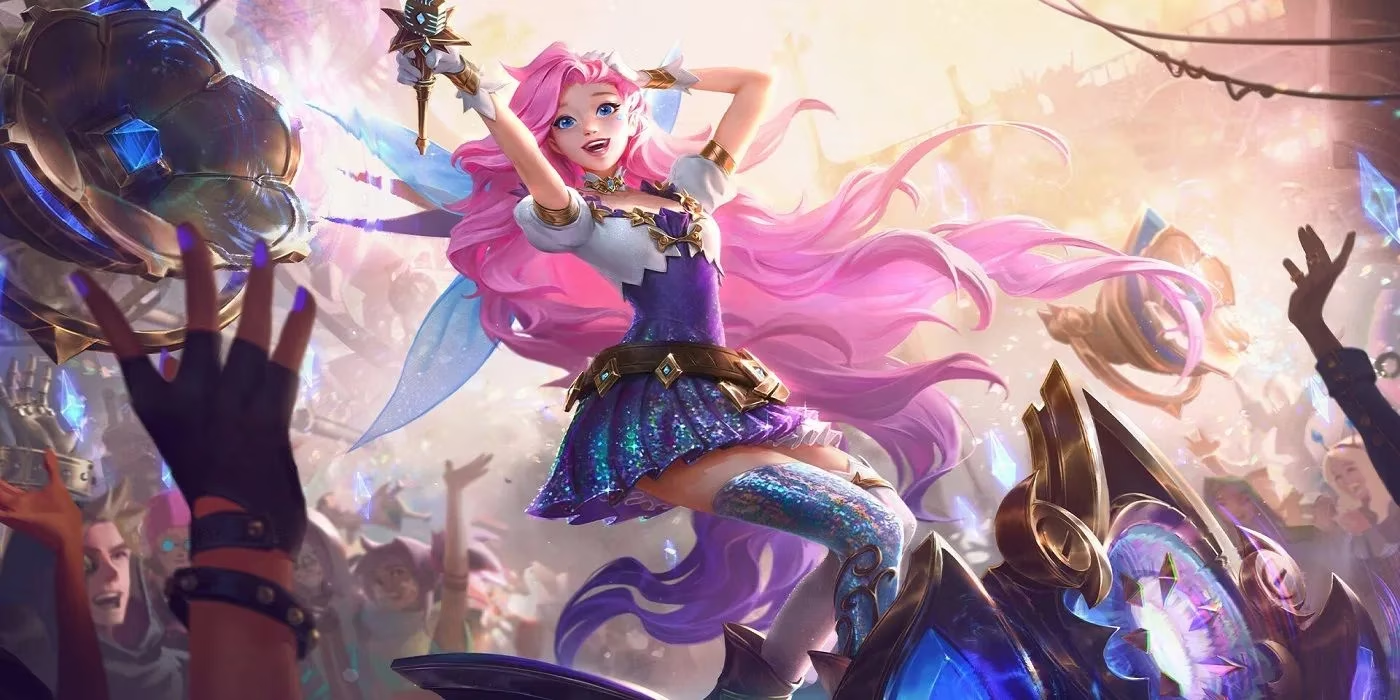
This Seraphine would be another knife in the side of Zaunite identity. Piltover would parade her as their own, scrubbing away the dirt and calling it "progress." They'd hand her hextech amplifiers and a stage in the Sun Gates while the original musicians choked on Grey fog. That conflict – the theft of culture – is a theme that echoes through every story the two cities share. Our actual Seraphine? She just warbles about togetherness, oblivious to the fact that her very existence could have been a lightning rod for social commentary. Riot had a golden opportunity to create a champion that forced players to ask uncomfortable questions, but instead we got a marketing tie-in with a beat drop.
📺 The Arcane Gambit
What makes this whole mess even funnier (in a cry-into-my-poro-plushie sort of way) is the timing. Back when Seraphine launched, everyone knew Arcane was brewing – an animated series set squarely in Piltover and Zaun. I remember thinking, "Alright, maybe they'll fix her in the show. Maybe she'll show up and have a purpose." Fast-forward to 2024, and Seraphine's cameo in Arcane was… a background poster. Ouch.
The series gave us the gut-wrenching sibling strife of Vi and Jinx, the political chess of Mel Medarda, the quiet desperation of Viktor. Had Seraphine been a rock star, she could have been a symbol of cultural appropriation, a mirror held up to Piltover's predatory relationship with Zaun. She might have been a friend to the Firelights or a sellout to the Enforcers. Instead, she remained a pretty footnote, eternally disconnected from the very world that made Arcane a masterpiece. It's almost poetic how thoroughly Riot sidelined her, as if even they realized she didn't fit the narrative.
🎤 The Final Curtain Call
Look, I'm not here to be a grumpy gatekeeper. I own K/DA skins. I've hummed "POP/STARS" in the shower more times than I'll admit. Seraphine was a masterstroke of commercial branding, and in the K/DA universe, she's right at home with her glittering outfit and overpriced ultimate skin. But when you drag that same character into the core lore of League of Legends, you'd better make sure she can stand on her own two feet. Seraphine fell flat, and after six years, that disappointment still stings.
Thankfully, Riot's track record since then has been stellar. The 2025 expansion of Shurima's ancient empire, the heartbreaking Noxian civil war plotline – the narrative team has proven they can weave deep, resonant tales. Seraphine remains a curious blip on the radar, a reminder that sometimes, a pretty face can't hide a hollow story. Whenever I see her twirl across the Rift in a ranked game, I can't help but smirk. She's a time capsule from an era when Riot almost forgot what made Runeterra special. At least we still have Camille's brutal voice lines to remind us what real Piltovan steel sounds like.