
The Evolution and Impact of New Game Plus in Modern Gaming
Ghost of Tsushima and New Game Plus revolutionize replay value, letting players relive epic tales with their hard-earned progress intact.
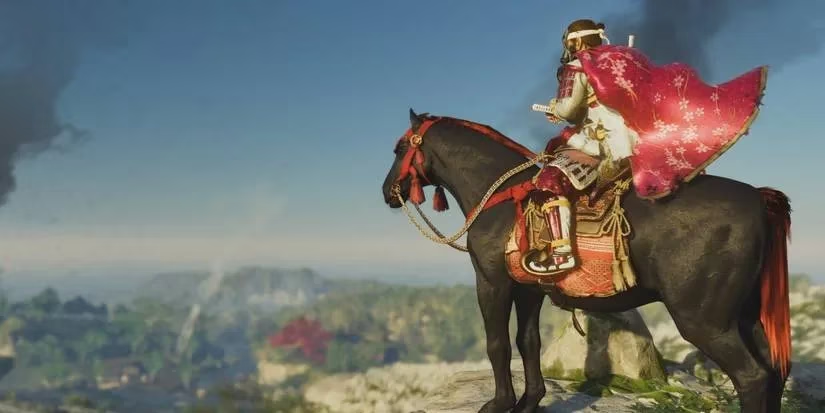
For countless gamers, the final credits of a beloved title often bring a bittersweet mix of satisfaction and longing. The experience was so compelling that the desire to relive it is immediate, yet the prospect of starting from zero can feel like an overwhelming task. This is where the concept of New Game Plus becomes a beacon of hope, transforming a potential 'show hole' into a renewed adventure. A prime example is the journey of Sucker Punch's Ghost of Tsushima. Upon its initial release, the absence of a New Game Plus mode left a palpable void in the community. The game's captivating world and narrative were so powerful that many players chose to replay the entire story on a fresh save file—a testament to its allure. However, not every game commands such devotion. Recognizing this, the developers later introduced a dedicated New Game Plus mode alongside the Legends multiplayer expansion. This addition allowed players to revisit the shores of Tsushima with their hard-earned progress intact, offering a fresh perspective on Jin Sakai's tale and proving that even the most celebrated experiences can be enhanced by respecting a player's investment of time and skill.
The Genesis of a Replay Revolution
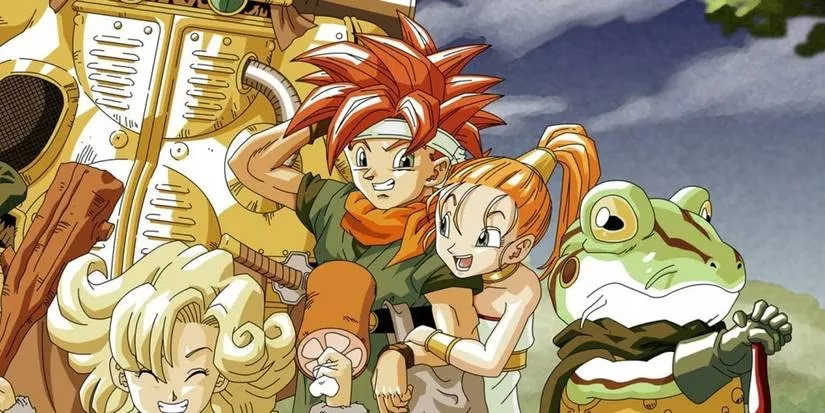
While the term "New Game Plus" has become a staple in gaming lexicon, its origins trace back to a legendary title from the mid-90s. The concept was formally coined by Square Enix's Chrono Trigger in 1995. This groundbreaking feature allowed adventurers to restart their journey through time with all their accumulated equipment, skills, and statistics. It was like a time loop where the traveler retained the knowledge and tools from their previous cycle. This wasn't merely a convenience; it fundamentally altered the game's structure. Players could challenge the final boss, Lavos, at almost any point, with the timing of their victory weaving different narrative threads and unlocking multiple endings. New Game Plus became a master key for exploration, enabling fans to witness the story's many facets without the grind of repeated beginnings.
However, the seeds of this idea were planted long before. The gaming landscape has always experimented with rewarding mastery:
-
Arcade Era 🕹️: Early arcade cabinets would often restart with increased difficulty after a player completed the game, a primitive form of cyclical challenge.
-
NES Classics: Titles like Super Mario Bros. introduced more demanding versions of levels (often with faster enemies) upon a successful first playthrough.
-
The Predecessor: One of the most direct forerunners was The Legend of Zelda II: The Adventure of Link. Upon completion, players could restart their quest with their experience levels and items preserved—a feature that, while unnamed, was the spiritual ancestor to the modern New Game+.
Modern Mastery: How New Game Plus Transforms the Experience
In contemporary gaming, New Game Plus is no longer a simple carry-over; it's a sophisticated tool for deepening engagement. In Ghost of Tsushima, activating this mode places Jin back on the fateful beach at Komoda, but he is no longer the novice samurai. He enters the fray like a seasoned ghost, a silent predator armed with the full arsenal of techniques and gear from a prior life. The game responds in kind, introducing:
-
New collectibles and equipment 💎
-
Enhanced enemy difficulty and AI ⚔️
-
Fresh cosmetic options and challenges
This creates a beautifully inverted dynamic. The familiar story is now a stage for power fantasy and strategic experimentation. Players can approach combat encounters not with trepidation, but with the creative freedom of a master painter revisiting a classic canvas with a broader palette. The world feels simultaneously known and new, like reading a favorite novel but suddenly understanding all the subtle foreshadowing you missed the first time.
A Spectrum of Second Chances: Variations on the Theme
Modern implementations of New Game Plus are wonderfully diverse, adapting the core concept to suit different genres and design philosophies.
| Game Title | NG+ Implementation | Unique Twist |
|---|---|---|
| Demon's Souls (PS5) | Classic carry-over of stats and items. | World Tendency persists, allowing players to explore narrative branches (e.g., Pure Black vs. Pure White) they may have missed. |
| Final Fantasy VII Remake | "Hard Mode" after completion. | Players keep abilities and gear but cannot use recovery items or restore MP at benches, demanding perfect resource management and strategy. It's a tactical reboot that recontextualizes every battle. |
| Fire Emblem: Three Houses | Carry-over of Renown and statue bonuses. | Allows for profound customization of subsequent playthroughs, unlocking support conversations and class paths at an accelerated rate. |
These examples show that New Game Plus can be as punishingly strategic as Final Fantasy VII Remake's Hard Mode or as liberatingly powerful as the cycle in Demon's Souls. It acts as a developer's permission slip for the player to break the intended progression, turning a linear journey into a sprawling sandbox of possibilities.
The Notable Absences: Games That Leave Players Wanting More
For every title that perfects the New Game Plus, others highlight its absence like a missing piece in a puzzle. Cyberpunk 2077 serves as a prominent example. Despite its vast, dense world of Night City, the game famously launched without this feature. Players can reload a save before the point of no return to continue side activities, but the core narrative remains a one-time journey per character. Given the game's wealth of missable iconic weapons and narrative choices, a New Game Plus mode would be the perfect vehicle for comprehensive exploration, allowing V to become a cumulative legend across timelines. Its absence forces fans to craft entirely new personas from scratch to see different outcomes, which can feel like an unnecessary barrier to full enjoyment.
Similarly, Dragon Ball Z: Kakarot offered a lovingly crafted story retelling but lacked meaningful post-game replay. Its time machine feature lets players revisit story missions, but without scaled enemy levels, Goku and friends become overwhelmingly powerful, reducing epic battles to trivial one-hit encounters. A proper New Game Plus, where Saiyan power is met with equally formidable foes, would transform it from a nostalgic trip into an endlessly engaging power struggle.
Conclusion: The Enduring Legacy of the Second Playthrough
As we look at the gaming landscape in 2026, the New Game Plus feature has evolved from a niche bonus into a respected pillar of game design, a tacit acknowledgment that a player's time and achieved mastery have value. It is the bridge between a story's end and its new beginning. For titles like Ghost of Tsushima, it transformed fan disappointment into deepened loyalty. A well-executed New Game Plus is like a master chef offering a degustation menu after a superb main course—it's a curated, elevated experience that celebrates everything the player has learned. It ensures that a great game is not just a memory to be cherished, but a world that can be re-inhabited, re-explored, and re-mastered, offering fresh joy long after the first adventure concludes. In an era where content is vast but time is precious, it remains one of the most player-friendly features a developer can implement.